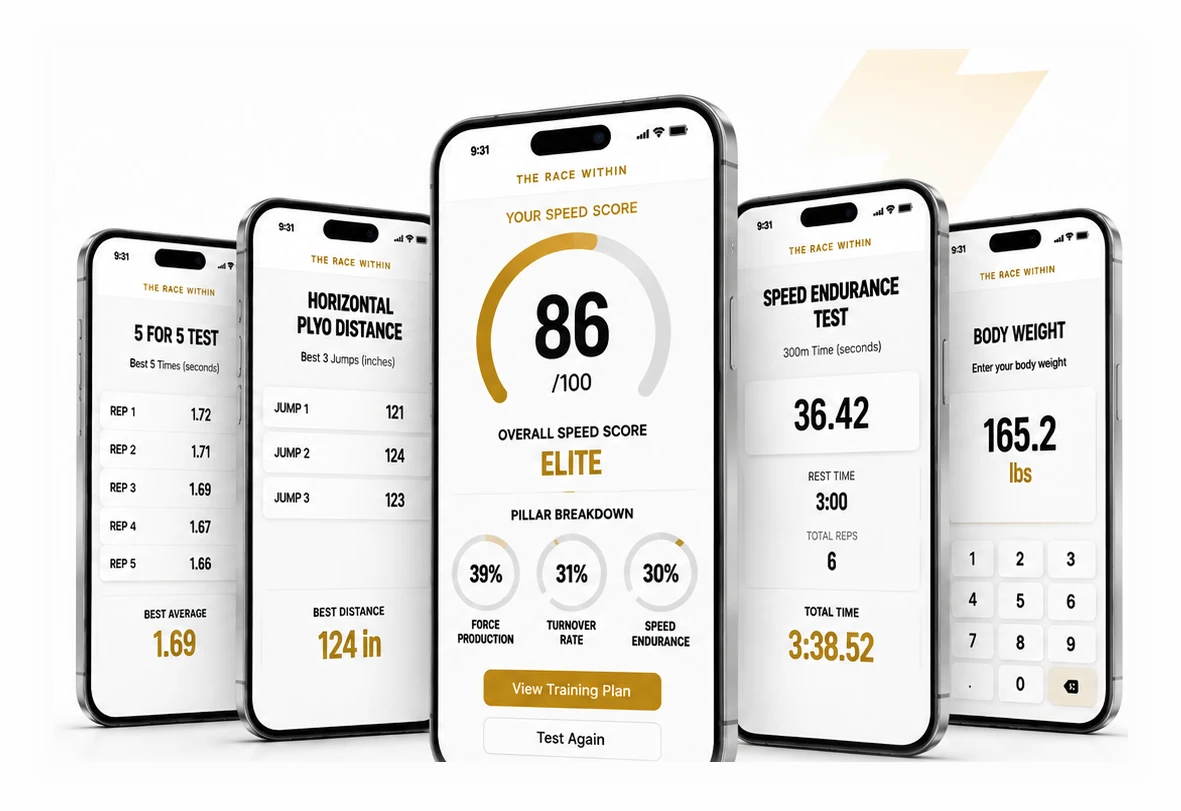
Find What's Holding Your Speed Back
TRW is finally here, and it's free. Run three tests, find the pillar that's capping you, and start fixing it today.
 Your Journey To Your
Max Speed Potential
Starts Here
Our Proven 4-Step
Speed Enhancement Framework
Every athlete follows the same proven path. Four steps. Zero guesswork. Maximum speed.
If you’re not tracking, you’re not trying
use the speed calculator
The 21-Day
Speed Challenge
Twenty-one days of focused work, one session at a time. You open the app, you get today's session, you go do it. That's the whole thing.
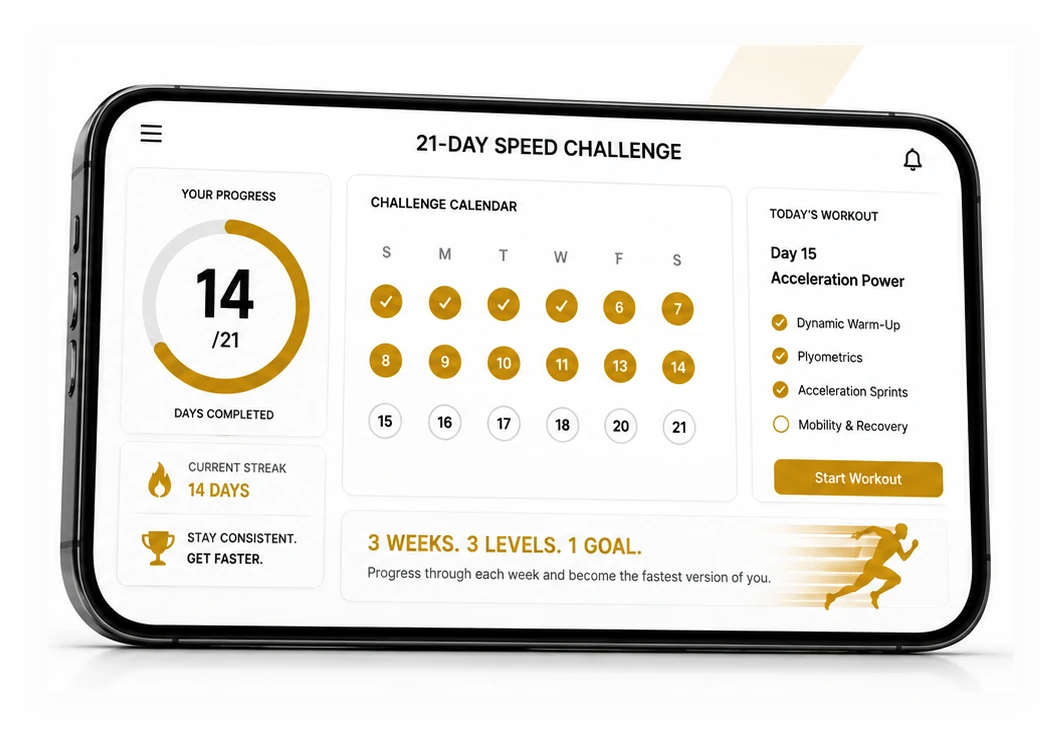
3 weeks · 3 levels · 1 goal
Everything You Need
In One Place
Start with the free tools, work the pillar that came back weakest, then add coaching when you want a second set of eyes on it.
Start here, free
Included in Basic. No cost, nothing to unlock.
The training system
The three pillar courses and the programming around them.
Coaching, tools and community
The parts a program on its own cannot give you.

Built by Athletes,
For Athletes
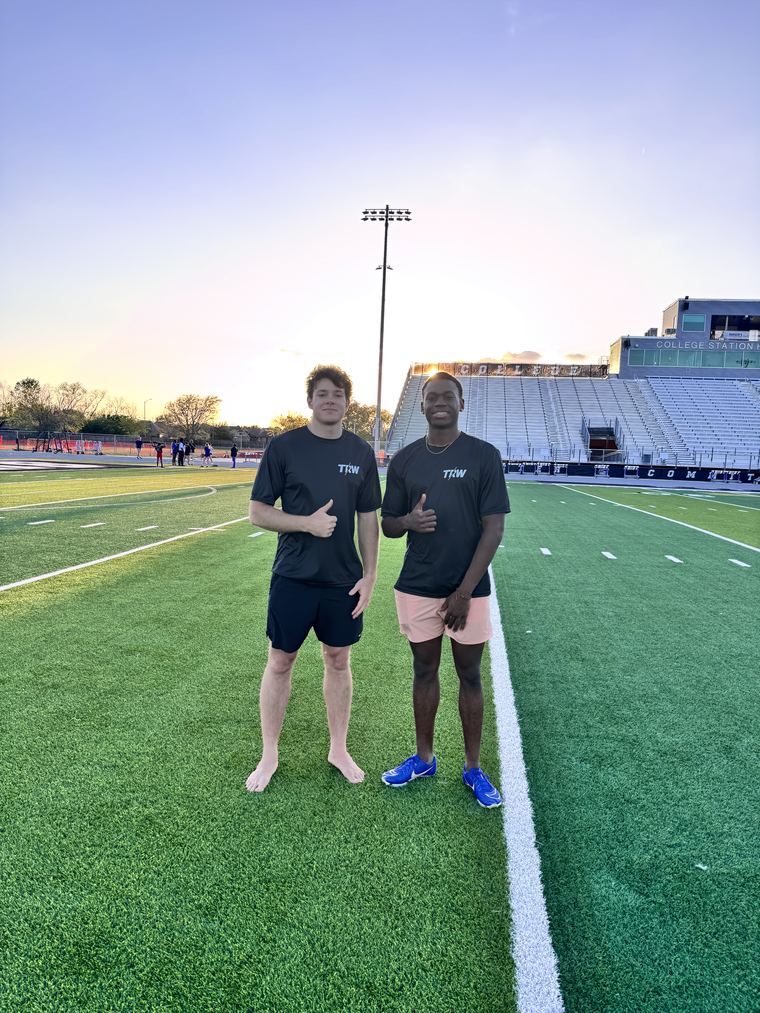
Issam was running 10.4, already fast, but he knew he had more in him if the right training and coaching was put in place. A year later, that was proved to be right when he broke multiple records. His training was focused on specifics based on what he needed at the time: coordination within explosive movements and overspeed training, which really turned everything up a notch for him. He described the overspeed training as a switch that activated him like never before and played a massive role in his indoor NB records. Shortly after, he ran 9.8 and beat Noah Lyles in an official 100 meter dash. Without the right guidance and personalization that was needed, who knows what would have happened.
That gap between 10.4 and 9.8 is the whole reason TRW exists. Most athletes never get a coach who can see the one or two things actually holding them back, not because the knowledge doesn't exist, but because getting access to it is rare. Which is why Issam collaborated with Luke, a friend and long-time speed trainer of his who's always pointed him in the right direction due to his speed training experience and certification. Luke even introduced Issam to overspeed training long before it showed up anywhere else. Together, Luke and Issam spent the next 3.5 years combining what they knew, testing frameworks, and refining what actually worked, until they created what they now call the 4-Step Speed Enhancement Framework.
This is the program and community we built to do for you what the right coaching did for Issam. Not motivation. Information, applied correctly, at the right time, starting today.
Real speed training is a science,
and most athletes never
get access to it…
Until now.
Start Free.
Go Pro When You're Ready.
Everything below the line is optional. TRW itself costs nothing.
TRW Basic
Everything you need to find your bottleneck and start working on it. No card, no trial, no expiry.
- TRW community and group chat access
- Full onboarding flow to map your own starting line
- Speed Pillar & MSF Calculator
- 21-Day Speed Challenge, beginner through advanced
- Course 1: Force Production Builder unlocks at level 2
- Bart Skips Routine unlocks at level 2
- Dash App founding member access pre-access
- Community leaderboards with monthly rewards
- Community calls with live Q&A and training tips
TRW Plus
All three pillar courses, the full seasonal system, and the recovery work that holds it together.
- Everything in Basic
- Course 2: Turnover Rate Builder
- Course 3: Speed Endurance Builder
- Pre-built workout plans, 8+ built for elite speed
- Full seasonal training program: off, pre and in-season
- Daily recovery, health and longevity plans
- Warm-up routines and stretch routines
- Weekly group calls, Plus members only coming soon
- 5-minute 1-on-1 onboarding and strategy call with Luke
- Full access to the TRW Playbook coming soon
- Everything in Basic
- Course 2: Turnover Rate Builder
- Course 3: Speed Endurance Builder
- Pre-built workout plans, 8+ built for elite speed
- Full seasonal training program: off, pre and in-season
- Daily recovery, health and longevity plans
- Warm-up routines and stretch routines
- Weekly group calls, Plus members only coming soon
- 5-minute 1-on-1 onboarding and strategy call with Luke
- Full access to the TRW Playbook coming soon
TRW Pro
Coaching with our names on it. Hand-written programming, direct access to us, and skin in the game on your result.
- Everything in Plus
- Full Inner Circle community access
- iMessage Inner Circle group chat
- 1-on-1 private coaching calls
- Fully personalized training program, written by hand for your goals and current condition
- Speed Force AI Coach, 24/7 access to the TRW knowledge base
- Issam and Luke's personal phone numbers
- Win Your Money Back: take back 30% of what you paid when you hit your goal with us
Speed Changes
Everything.
Find your limiting pillar, then go fix it. It costs nothing to start.
Join TRW FreeFree to join · Speed Calculator · 21-Day Challenge